24th March 2026

Why are Gas & Electricity Standing Charges increasing so dramatically?
Standing charges are increasing, but what does this mean for your business and why are they rising so much?

As a business owner, you might have noticed the rise in charges appearing on your electricity bill – outside of the current cost of energy itself. These are your Non-Commodity Costs. But what does that mean, what do they cover, and why are we seeing an increase in these charges?
All businesses have to pay non-commodity costs on their energy bills.
These are charges that cover network maintenance, government levies, and other third-party costs. These are all separate from the wholesale cost of the electricity you are using.
The commodity cost – this reflects the wholesale price of your electricity, but the non-comms, are covering the delivery of the electricity, the infrastructure and regulatory expenses. These costs are mandatory and passed through to you from the supplier of your electricity.
Non-commodity costs now typically represent 60-65% of a business electricity bill, often exceeding the wholesale energy cost, but what has caused this change?
This charge covers the cost of installing and maintaining transmission systems in England, Wales, Scotland and offshore areas. TNUoS has seen a significant increase from April 2026. The majority of businesses have seen TNUoS increases of an average of 62%, with some experiencing over 100%! We are expecting a further increase in April 27 of an average of 21% of these TNUoS costs.
This has been driven by:
1)Major National Grid investment programmes to support:
-Electrification of transport and heating
-Increased renewable generation capacity
-The UK’s Net Zero targets
2) Suppliers are also increasingly recovering RIIO-3 transmission investment costs through customer bills. RIIO-3 transmission investment is a significant initiative aimed at enhancing the UK’s electricity transmission infrastructure. As part of Ofgem’s price control framework, the investment is expected to support up to 130,000 jobs and contribute an estimated £4 to £11 billion of gross value to the UK’s economy by 2050.
3)New charges, including:
-TNUoS RIIO-3 Charge – linked to the investment above
-Introduction of the Nuclear RAB (Regulated Asset Base) Levy, a new charge designed to fund future nuclear energy projects which changes every quarter.
The changes in Distribution Charges (DUoS) have been mixed across the market. Some businesses have benefitted from lower standing charges, while others have seen an increase in agreed capacity charges and peak-time network tariffs. This impact can vary depending on geographic region, voltage level and consumption profile.
The Balancing Charges (BSUoS) costs continue to fluctuate as National Grid balances electricity supply and demand. BSUoS costs are predicted to increase next year. This is due to the prediction that the under-recovery of these costs will reach £1.1bn by the end of Winter 26/27. The reasoning behind this is because of the increase in global gas prices, with the war in the Middle East
Rising costs are challenging, especially when it is out of your control, even when wholesale electricity prices remain stable, overall energy bills can still increase due to rising non-commodity costs. The ongoing investment in our electricity network and energy security infrastructure is expected to keep these charges elevated for the foreseeable future.
As a business, there are steps you can take to ensure you try and reduce costs where you can. For example, if you are currently reviewing your energy contract, consider:
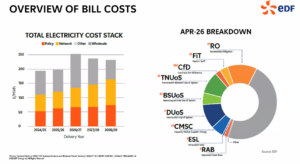
Source: EDF
Rising network and policy costs are becoming one of the biggest drivers of electricity bills, making it increasingly important for businesses to understand both commodity and non-commodity elements when planning future energy budgets. It’s important for businesses to now look beyond the contract and think of their overall energy strategy.
This is where Lumina Energy comes in, our experts can look at the comms and non-comms within your energy and discuss the long-term strategy for your energy usage and requirements.
Reach out to our team on 01622 236 888 or contact us here.
Standing charges are increasing, but what does this mean for your business and why are they rising so much?
 https://luminaenergy.co.uk/wp-content/uploads/2025/02/RTS-Meter-Switch-Off-Lumina-Energy-500x300.jpg
There is a big change happening regarding Radio Teleswitch electricity meters on 30th June 2025 that will affect domestic and business properties so it’s important to know what is happen, when and what to do next.
On Tuesday 25th February the 2025 Kent & Medway Food and Drink Awards are being held at the Chilston Park Hotel, near Maidstone in a brilliant celebratory ceremony. This year we are back and sponsoring the Tearoom/Coffee Shop of the Year category and ahead of the awards our energy consultant Sally Paterson visited each of the finalists to say hello and hear all about their businesses.
Get in touch

Please get in touch using the form below.
